
Tomato-Potato
definitional nuance

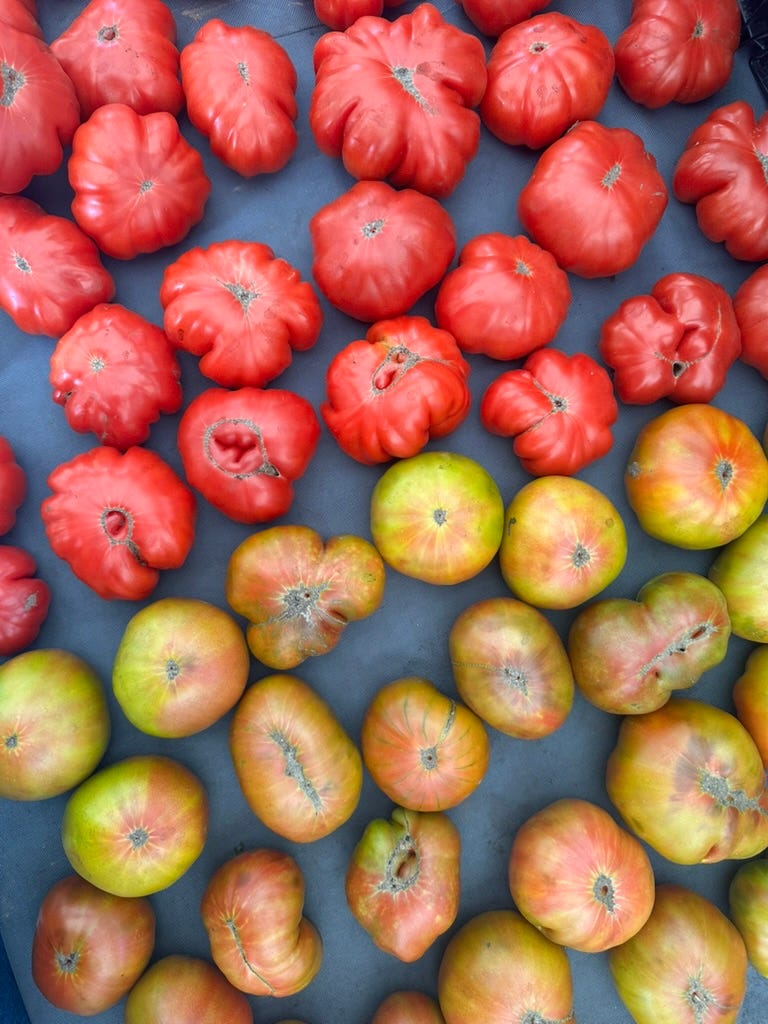
Today, I’m diving into the tomato-potato reference I introduced last month because narratives have power, therefore words matter.
Brief background: I look up the most everyday words every day, not because I’m trying to, but because I’ll come across a word that just feels off, hear it like a wrong musical note, and try to find a more harmonious one that then feels right. The definitions of these words often turn out being same-same-but-different, which sounds like tomato-toMAHto to some but tomato-potato to me.
A few notes first:
I generally try to stick with academic definitions because they’re the greatest common denominator and less likely to change over time, but there are instances when cultural or colloquial definitions are stronger than common ones. I share this because as much as I welcome you to challenge my interpretations of these words (especially in cultural or colloquial contexts), if you’re simply responding with an academic technicality, save your energy.
I use ‘or’ and not ‘versus’ between these words because none of them conflict with each other. I’m highlighting these words today because of how I’ve seen them conflict with narratives we tell ourselves.
These are listed in no particular order.
Alright, let’s get going:
predictability or stability
Copy-pasting the example I wrote last month: Freelancers have told me they’re thinking about returning to full-time because they want “stability,” but in many cases, what they’re really after is predictability - of income, team, pipeline, or a type of work and deliverable.
While I was freelancing, people didn’t hesitate to tell me that I had no stability (which was my first priority), and most of the time, I let them believe it even though that’s not how I felt. Stability to me meant cash flow, and I had more than enough on hand to maintain an abundance mindset (which is all I wanted because scarcity mindsets can lead to self-fulfilling prophecies). I may not have had as much project-predictability as others, but I had enough(!) to not jeopardize my sense of stability.
preparation or planning
Preparation is rooted in readiness, and I see it being brain-based before all, like the way we talk about being mentally-prepared, which comes before being informationally- or physically-prepared. Planning to me is more defined and action-based.
Example: when a recruiter would tell me that a company wanted to schedule an interview, preparation was knowing where my interview materials were and how much time I needed to get ready. I wouldn’t actually do anything actionable (e.g., get smart on the company, know my talking points) until an interview was scheduled.
Why is this nuance important? First and foremost, because life still happens while I’m planning it, so there’s a trade-off in being less present. Second, it takes more energy to plan than prepare.
what you do or who you are
Identity is such a tricky thing to talk about so I won’t dive deep here. But when people ask me how I seemingly(!) seamlessly navigate between functions (e.g., strategy, marketing) and industries (e.g., sport, tech, retail), I tell them that I think the first obstacle to hurdle is the one they often make themselves…I don’t see myself as a marketer or a strategist – I see myself as having expertise in marketing and strategy, the same way I have or am building expertise in other areas. I just generally avoid anchoring my identity in what I do. (Side note: here's an old SOAR piece about anchoring.)
This is definitely more of a preference-based tomato-tomahto than tomato-potato, but it matters to me because at the end of the day, part of how others see me is a function of how I see myself. And in all sincerity, if I’m any kind of marketer, it’s a farmers-marketer above all.
wealth or privilege
Wealth is purely monetary; its advantage sits under a larger umbrella called privilege. But there are different kinds of privilege, and I’ve always thought about how much more powerful privileges like access (to knowledge, people, places, restaurant reservations, etc.) are than wealth alone. Wealth undeniably aids in unlocking different dimensions of privilege, but it’s not a prerequisite and that’s what I try to remind myself.
While we’re on the subject, a few personal opinions:
Everyone has privilege(s) of some kind. Whether it’s as appreciated or coveted is separate from whether privilege exists.
I don’t judge people who have privilege; I judge people who don’t share it. Please please please let that sink in and consider behaving accordingly.
attention or appreciation
Attention is simply being noticed, whereas appreciation includes being valued.
I don’t feel that society as a whole naturally appreciates and rewards the way I operate, so there are days when I wonder if I should sell out for attention, but the thought of encouraging the very thing that I despise makes me feel empty and gross - here’s why.
If you’re wondering what an attention-first approach looks like to me, I’ll illustrate using SOAR. I could make the titles more straight-forward and search-friendly than Tomato-Potato, write click-bait like how to get a job at Nike, and create frameworks and checklists for people to feel productive (even when I only see it as busy work…). And here’s the thing: it’s not that I don’t know how to - it’s that I fundamentally don’t want to; it’s simply not aligned with what I want readers to get out of SOAR. Interestingly, my style of writing might be(come) the only reason why you believe these aren’t AI-written.
confidence or comfort
The easiest thing for me to do is to direct you here and add that confidence comes with evidence - it’s what you already know you can do because you’ve done it, like eat a peach and hug a friend. I’m not always confident that I can do something, but my comfort in trying is perceived as confidence because my darling friends don’t see me failing (even when I do); at worst, they only see me trying. (I absolutely cannot overstate the power of emotional safety here…should you have the privilege of finding it, cherish and protect it.)
status or skill
Specifically in the world of work, this one’s tricky until it’s not…at some point, most people realize that status is not necessarily the result of skill. When I’m talking skill here, I’m referring to an area of expertise outside of workplace politics (which I acknowledge is a skill). Barack Obama kind of touched on this here.
I’m now going to state the obvious…not every manager/leader/C-suite is hired for reasons that you value; it’s your job to discern and decide if a person with status is someone you want to work with and learn from. (On the scarier side, it’s wise to ask how status can be used and abused, and the pros/cons of affiliating.)
kindness or niceness
When it comes to people you care about, being nice is the insult to being kind. Being nice is about comfort — it lives and fades in the moment. Being kind is about building beyond it. Niceness makes someone feel good right now. Kindness makes someone better, in and over time. The courage to choose kindness is how to show you truly care.
free mind or free time
Free time is merely mins in a day; finding it feels like a linear equation where you’re solving for predictable constraints. Free mind, on the other hand, feels more to me like calculus (i.e., the mathematical study of continuous change!); this is harder to solve for because variables like health, emotions, and other humans are more dynamic than time alone.
Surprise, surprise!
We don’t live in a world that is exclusive to ‘or’ and need to embrace ‘both/and,’ so here are the word pairings that I hope we forever-couple and balance like yin and yang.
Perception and reality
Talk about the power of narrative…I don’t need to explain why both are relevant, but what I’d like to highlight is the obvious reminder to not lean into perception so much that you lose your grasp of reality (which I recognize can be relative). Personally, I think it’s both easy and a mindfuck to do things for likes because as much as I know how to play the game, the game plays with my peace of mind. It makes me wonder if I can trust people for my right reason(s)…are these people interested in me for me, or it (i.e., something they’re hoping to benefit from)? This leads to more questions like, should I care?? For the sake of staying on topic, I’ll pause here and say that this loosely ties back to the first two bullets in this post about whether people demonstrate curiosity or care.
Am I less “successful” because I avoid playing the game? Most definitely, but I’m also healthier because of it, and the body keeps the score (as Bessel Van Der Kolk’s book is so brilliantly titled).
If I’m going to play the perception game, I generally choose to play it differently - more earnestly and with less mimicry so there’s less of an ick factor.
hype and heart
I could talk for hours about the layers of hype and heart, but simply put, I think hype is what differentiates us, and heart is what connects us. We need both; it’s a tale as old as time.
what is and what if
Practical and possible. I’m frequently called out for being pragmatic and romantic, though not often at the same time or by the same people. So much of this is about time and place - how I see (with practicality or possibility) is as much a function of where and when as it is free mind and free time.
time and energy
If you’re of average health, then I see energy as finite and time as infinite. YUP, you read that right. If you disagree, then what bridges our POVs is likely in how we prioritize. I learned a long time ago that I might not always have time, but am one to make it. In accepting that, my challenge becomes aligning time with energy to unlock a flow state.
Parting words
This is merely a starting list. Are there more word-pairings worth talking about? Of course; just last week, ‘self-preservation or self-protection’ was especially top of mind, but today’s list captures what has regularly come up as I chat with you dear readers.
More importantly, this is merely my list (I’d love to know yours). Some of my interpretations might not make sense, and that’s okay! But if by chance this helps improve your thinking or narrative, I’m glad, x.