
Chicken or the egg
on maintaining self-worth and finding my dozen

Hi! ICYMI: This is part of a 3-day series — here’s Day 1 and Day 2.
Self-worth is earned.
In marketing, we call this a human truth — a fundamental and timeless observation that underlies the human experience. And the truth is, regardless of how self-worth is earned, there comes a point when it’s put in question and you get to decide whether and how to maintain it, or (if needed) regain it. It’s in these moments that you ask yourself who you are and who you want to be, whether you realize it or not.
When I first shared this human truth, I didn’t get into how it’s earned because the path towards it varies, but the journey of asking yourself who you are and who you want to be is more uniform. It starts with the self, ideally beginning with lucid self-awareness, ruthless self-accountability, and alignment with your self-competency. And as much as I wish your worth could start and end with you, it’s inevitably shaped by others, and rewarded two ways: attention and/or appreciation. Attention in this context means being noticed (positively or negatively) whereas appreciation translates to being valued (by yourself as well as others).
You can care but you can’t chase.
This, in my opinion, is how self-worth is maintained. It’s the line that separates desperation and dignity, requiring (a) discipline to align who you are and who you want to be, and (b) skill (+ luck) to be recognized and appreciated for it (including by yourself).
The discipline to care-but-not-chase is easier said than done, but this is when the distinction between attention and appreciation becomes important. Chasing self-worth out of desperation is a chase for attention — fleeting, transactional, nominal — because appreciation can only be earned, and it takes EQ to accurately discern.
Answering who I am and who I want to be
I’m going to selfishly take this opportunity to first start with who I am not wired to be: Type A — I’d be stupid rich if I had a dollar for every time someone has told me I am. What they don’t understand is that attentiveness is customary in East Asian cultures, so I’m organized for others’ sake, not mine. Personally, I find to-do lists a waste of time and the supposed satisfaction of finishing one self-aggrandizing.
(who I actually am and will likely always be: a combination of Types B and C)
I’m not achievement driven (I’m appreciation-driven). I sincerely have no interest in being the best, but have every interest in working with and learning from them to do my best. They are my greatest source of curiosity, care, and creativity, but there are no pedestals here; we’re all human — flawed, becoming, beautiful.
Lastly, I despise being put in a box; we’re all so many things (if not today, tomorrow). But for the sake of this post, I’ll tell you what I say most in relation to this question:
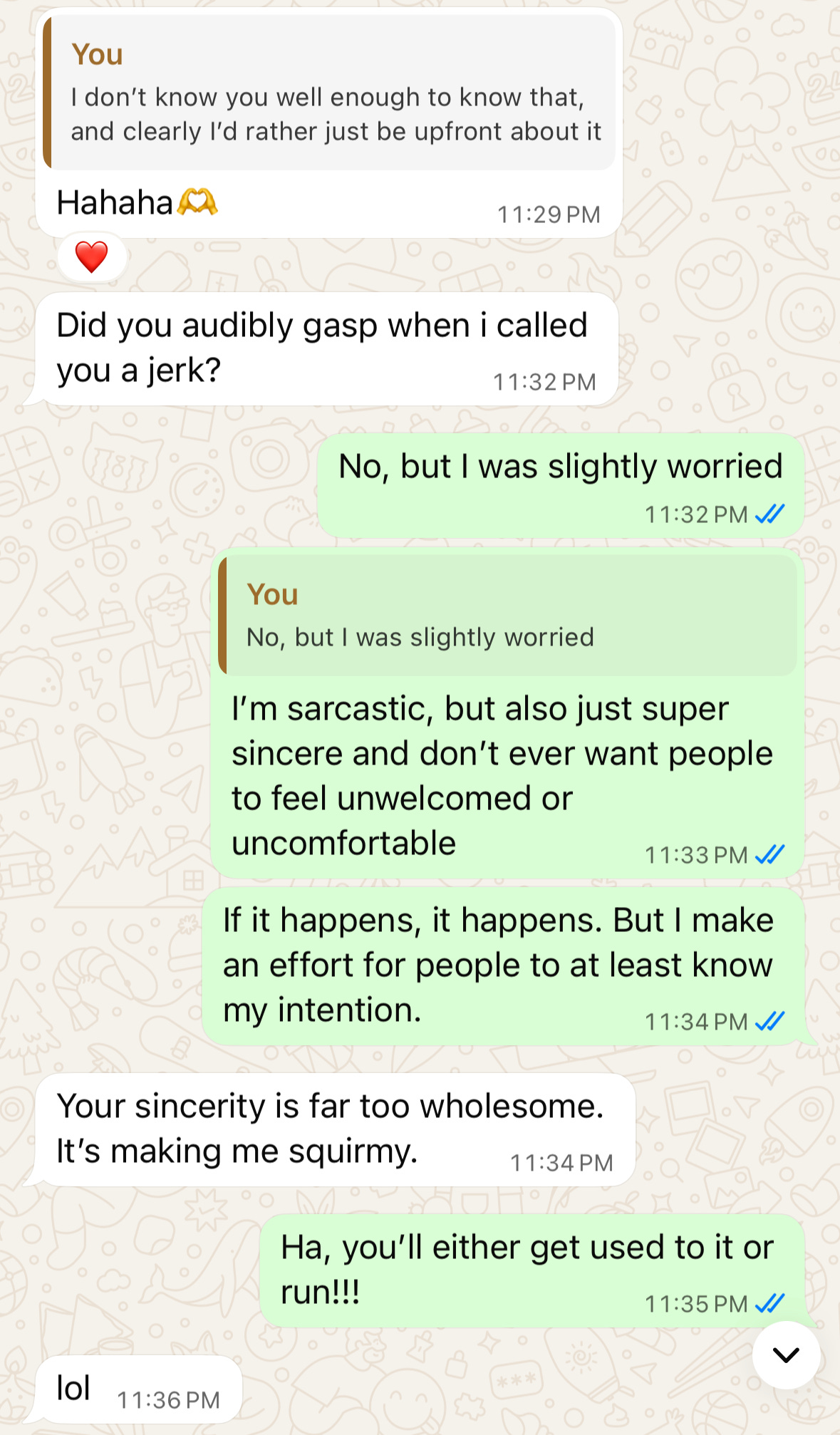
I’m reasonably sassy for someone who’s unreasonably sweet. Which sides you see depends on person/place/time, but this balance keeps me from coming off as too sappy, which I’m already enough of to some:
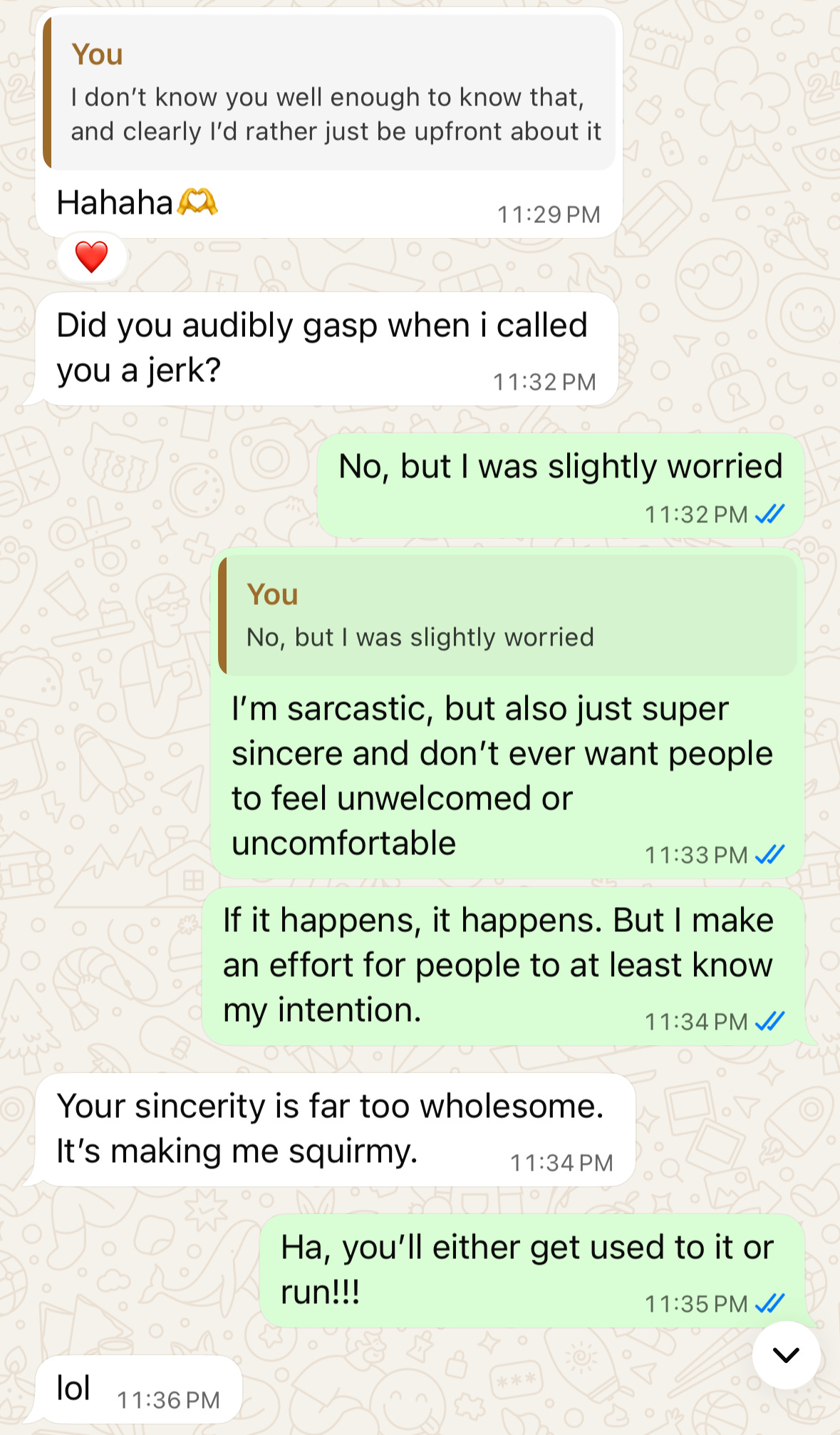
This one ran 🙃 sincerity and vulnerability are not appreciated by everyone. Side note: If you’ve never met Sassy Cat, it’s usually because I either wholeheartedly agree, or you’re not worth my energy to explain why I disagree.
I’m a good egg just trying to find my dozen.
(who I also am: good at one-liners)
Finding my dozen
I’m lucky to say that I’ve found a few dozen. I can’t take credit for what makes them so good, but think the tone I set lets me recognize them faster than others often can. Explaining how I do this starts with a soulless question:
On a scale of 1-5 (5 being great), what do you assume someone is when you first meet them?
Go ahead, take a moment to answer. If you’re hesitant to, you’re not alone. Rarely does someone simply give me a number. They first…
ask reasonable questions — how do I know them? what are we measuring them on (e.g., competence)? I tell them that none of these questions are relevant.
suggest I’m oversimplifying this and imply that I’m wrong to whittle someone down to a number. I completely get where they’re coming from.
Eventually, though, we get to a number. Most people choose 3 out of fairness and pragmatism; they’re applying the rules of probability while remaining open-minded. Some people choose 1; they make each egg prove its worth (often times, because they themselves had/still have to). Very few folks say 4 and the reasons here are split; some are truly optimistic about an egg while others want to virtue-signal. No one, to date, has ever said 2 (and if anyone does hereon out, I’m going to assume it’s because they read this). And only 1 person has ever said 5; I know this person well enough to know it’s sincere, but when I asked why, the person couldn’t tell me.
Before I share my answer, there’s one I’ve heard more often than I’d like because it says more about them than any other: “Eggs will start at 3, but won’t know it because I treat them like a 5.” YIKES. If this is you, it’s time to check your hubris. Chances are you’ve been on the other side and knew exactly what was happening, which means the only person you’re kidding is yourself. Even Sassy Cat doesn’t think it’s worth the energy to explain the arrogance in your answer, so instead, I often just skip to the logic in mine…
My answer is 5, full stop. Friends who’ve met Sassy Cat are often surprised to hear this, and I don’t blame them; there was a time when I would’ve said 3, but my logic was incongruent with my intent. If I truly want to be a good egg trying to find my dozen and concede to the laws of probability, then I needed more than good intent; I needed a strategy.
At the heart of every good strategy lies competitive advantage, and starting people at a 5 would give me mine. How exactly? Because when I treat people like a 5, I find out sooner if they’re a mother-fuckin’ 6!
Let’s use 3 to illustrate why any number less than 5 is a less effective answer (assuming you’re looking for good eggs): When people tell me that they start eggs at a 3 and I ask them what makes a 4, the reality is that most people can’t articulate it; it’s one of those “I’ll know it when I see it” situations. So now, you’re both just trying to work towards a 4, and if you’re open-minded enough and the egg is good enough, you might try and work towards a 5.
But if you start eggs at a 5, they’ll show you who they are free of your judgement. Also, you’ll know pretty soon if they’re not a 5. Sliding down that scale is easier than it is to slide up, and I find that people are often more reasonable about it, too. For example, if a supposed-good egg is 10 mins late, you’re more likely to give it the benefit of the doubt and attribute it to understandable circumstances (e.g., the subway was caught behind another train) instead of unfortunate disposition (e.g., the egg is not good / irresponsible).
At the end of the day, there is always a starting point. Where you set yours says a lot about who you are and who you want to be.
Reality and Rationale
This decision doesn’t come without consequence. The reality is that few people show up as 5s and even fewer as 6s (because life sure is something, amirite?!). But I do my damned best to be fair, and this is currently the fairest way I know to keep my own shit from getting in the way.
(who I am and who I want to be: someone who repeatedly gives people the opportunity to show up)
Having enough self-awareness to not project onto others has afforded me an ability to learn about people more sincerely and see them more clearly, which has sharpened my foresight.
(who I am and hope to always be: highly perceptive)
Spend enough time with me and you’ll see this perception in action, and learn how rarely I’m wrong about people (which is not the same as being right!). When I am wrong, it’s usually not because I’ve misjudged potential (capability and/or capacity are definitely present); what I’ve misjudged is what constrains it (e.g., limiting beliefs, self-preservation, trauma, pressure, fear). No one is immune to the trials and tribulations of life, so the question becomes, to what extent do these factors inhibit intention and potential?
(who I am and who I want to be: someone who checks my ego wrt what I know)
(who I am and wish I were less of: someone who is regularly disappointed in people…which is messed up, but I just really want people to reach the potential I see)
Disappointment is a harsh emotion that even the soundest rationale can’t curb, but that hasn’t stopped people from trying. A dear friend once attempted to by playfully saying, “you’re just so hard to please.” I get what he meant, but in true Sassy Cat form, I clarified what I really am — “easy to please, hard to impress” — which led to a look of both annoyance and agreement (signs of well-executed sass).
(who I want to be: great(!) at one-liners)
I share this because I think there’s a difference between what’s ‘easy to please’ and ‘hard to impress’ — it’s in that sense of self (i.e., ego) and whether action(s) elevate or erode it.
Nearly everything in the ‘easy to please’ bucket (e.g., being on time, replying to a text/email, checking in on a friend, showing support and encouragement) tends to make you feel good and elevates your ego in ways that feel like a pat on the back. In short, good job!
The same can’t be said about the things that will impress me. These actions demonstrate vulnerability in ways that are thankless and hard, not every time, but enough times. Somewhere in the journey of being impressive and staying impressive is the humility you endure in spite of your actions and ambitions.
To me, what’s more impressive than being a 6 (a function of how others see you) is your true ability to start others at a 5 (a function of how you see them). This isn’t something everyone can do because it can’t be faked; it’s a genuine expression of who you are and who you want to be (and whether you’re reached a certain stage in your journey). And if you’re like me, each and every good egg is worth the sting of so much disappointment and rejection along the way. Because 苦盡甘來 (translation: bitterness finishes, sweetness begins), remember?
(who I am and who I want to be: someone who makes decisions based on net-positive outcomes)
My ask of you
Yesterday, I shared that Tone, Place, and Pace is for multi-round players. And what I’m asking you to consider today — to start people at a 5 — is entirely reasonable, especially if you’re only asked to do it once. The question is whether you’re willing to do it every time.
I aim to, every time, which is not to say that I show up this way every day (because I don’t!). When I’m down, I stay down. I look inwards. I do the work. And assuming I already know who I am and who I want to be, then it just means I rest until I can reimagine how things could've played out, realign with who I am and want to be (through quality time with friends who appreciate me), and recommit to the decisions that enable me to start eggs at a 5. Then, repeat.
(who I am and who I want to be: eventually resilient following disappointment)
One more human truth
6s are special; not everyone is going to be one. It takes a special permutation to be seen as and to behave as a 6. But so many of us are 5s deep down; I’m certain of this. Whether we have the courage to show up as best ourselves — as 5s — is a decision that only we can make, and I’m so hoping we (i.e., you and I independently) will.
I can’t possibly chase you all to show up as and start others at a 5, but dearly care whether you do because of what I’ve said before: like begets like — passion begets passion, kindness begets kindness, and good eggs beget good eggs — all because of one more human truth: we are the company we keep.
Thank you for being in SOAR’s good company.
(who I am and will always be: net-hopeful, forever grateful)
That’s a wrap for this series! It’s hard to explain just how much writing this took out of me. Please share thoughts and critiques — I have plenty of my own 🙃 Just reply to this email or comment below.
This is the self-reflection -> awareness I need going into a new role and team.
You make me think and evaluate. Even when I don’t want to. Thank you.